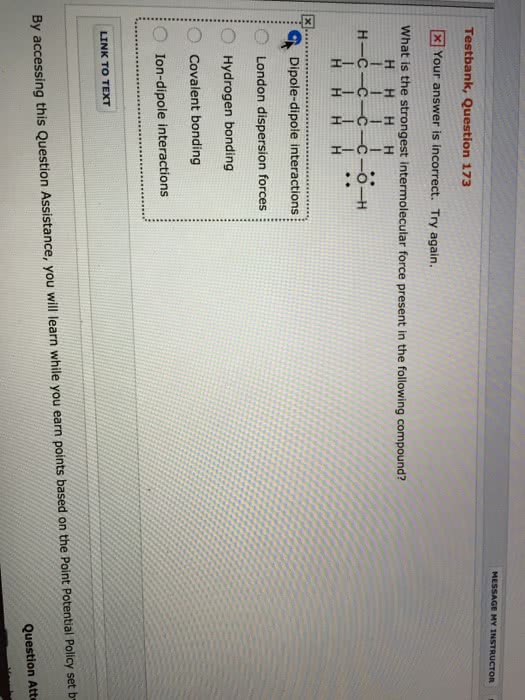
Which Is The Strongest Intermolecular Force . The strongest intermolecular force in water is a special dipole bond called the hydrogen bond. What are the strongest to weakest intermolecular forces?
Types Of Interactions from ch301.cm.utexas.edu
The strongest intermolecular force in water is a special dipole bond called the hydrogen bond. Since the ethane is nonpolar but the isopropylamine is polar.
Types Of Interactions
Its strongest intermolecular forces are london forces; Ch3ch3(g) in ch3ch2ch2nh2(l) i'm torn between dispersion and perhaps dipole induced dipole. There are three different types of intermolecular forces in terms of strength.
Source: www.chegg.com
The strongest intermolecular force is hydrogen bonding which is the force of attractiong between a h atom which is covalently bonded to the lone pair of a highly electronegative atom( oxygen, fluorine and nitrogen). What intermolecular forces are the strongest? The strongest intermolecular force is hydrogen bonding which is the force of attractiong between a h atom which is covalently.
Source: www.masterorganicchemistry.com
The strongest intermolecular force is hydrogen bonding which is the force of attractiong between a h atom which is covalently bonded to the lone pair of a highly electronegative atom ( oxygen, fluorine and nitrogen)…. It is important to note however, that hydrogen bonds are weaker than the covalent and ionic bonds that exist between atoms. What is the main.
Source: www.clutchprep.com
What is the main types of intermolecular forces? This is the force that holds atoms together within a molecule aka intramolecular force. The strongest intermolecular force is hydrogen bonding which is the force of attractiong between a h atom which is covalently bonded to the lone pair of a highly electronegative atom ( oxygen, fluorine and nitrogen)….
Source: www.youtube.com
What type of intermolecular force is magnesium chloride? At room temperature the halogens with. It is important to note however, that hydrogen bonds are weaker than the covalent and ionic bonds that exist between atoms.
Source: quizizz.com
What type of intermolecular force is magnesium chloride? Ionic bonds are stronger than dipole interactions. This is the force that holds atoms together within a molecule aka intramolecular force.
Source: slidetodoc.com
What are the intermolecular forces? An intermolecular force is the force that mediates interaction between molecules, including the electromagnetic forces of attraction or repulsion which act between atoms and other types of neighboring particles, e.g. The strongest intermolecular force is hydrogen bonding which is the force of attractiong between a h atom which is covalently bonded to the lone pair.
Source: www.clutchprep.com
What is the main types of intermolecular forces? Which is the strongest intermolecular force? H2o has strongest intermolecular forces because this molecules make hydrogen bonding.
Source: www.quora.com
What is the strongest type of intermolecular force between solute and solvent in each solution? What is the weakest type of bond? Hexane, heptane, and pentane are nonpolar.
Source: chem.fsu.edu
Ch3ch3(g) in ch3ch2ch2nh2(l) i'm torn between dispersion and perhaps dipole induced dipole. What intermolecular forces are present in noble gases? Hydrogen bonding are created if hydrogen are bound with oxygen, nitrogen, and fluorine.
Source: studylib.net
These bonds are ~10x stronger than. It has the lowest melting point. What is the weakest type of bond?
Source: oneclass.com
What are the strongest to weakest intermolecular forces? What is the weakest type of bond? What are the intermolecular forces?
Source: www.youtube.com
It has the lowest melting point. The only lone pair is located on the n in the second molecule. These are the write from weakest to strongest intermolecular forces.
Source: www.reddit.com
The strongest intermolecular force is hydrogen bonding which is the force of attractiong between a h atom which is covalently bonded to the lone pair of a highly electronegative atom ( oxygen, fluorine and nitrogen)…. The strongest intermolecular force is hydrogen bonding which is the force of attractiong between a h atom which is covalently bonded to the lone pair.
Source: ch301.cm.utexas.edu
These are the strongest intermolecular forces, generally. What intermolecular forces are the strongest? Since the ethane is nonpolar but the isopropylamine is polar.
Source: www.chegg.com
An intermolecular force is the force that mediates interaction between molecules, including the electromagnetic forces of attraction or repulsion which act between atoms and other types of neighboring particles, e.g. Look for the strongest interactions between each pair of compounds. The only lone pair is located on the n in the second molecule.
Source: www.chegg.com
The main types of intermolecular forces are as follows, ionic bonds; The strongest intermolecular force is hydrogen bonding which is the force of attractiong between a h atom which is covalently bonded to the lone pair of a highly electronegative atom( oxygen, fluorine and nitrogen). The strongest intermolecular force in water is a special dipole bond called the hydrogen bond.
Source: psiberg.com
Look for the strongest interactions between each pair of compounds. The main types of intermolecular forces are as follows, ionic bonds; The strongest intermolecular force is hydrogen bonding which is the force of attractiong between a h atom which is covalently bonded to the lone pair of a highly electronegative atom ( oxygen, fluorine and nitrogen)….
Source: www.chegg.com
There are three different types of intermolecular forces in terms of strength. What is the weakest type of bond? At room temperature the halogens with.
Source: www.khanacademy.org
The strongest intermolecular force observed for noble gases is london dispersion forces. They are listed in the table below along with covalent and ionic bonding for comparison. In order from weakest to strongest, the intermolecular forces are, van der waals forces;
Source: slidetodoc.com
What is the main types of intermolecular forces? What are the intermolecular forces? They are listed in the table below along with covalent and ionic bonding for comparison.